
A solution framework for Indian HNI families
If you spent a lifetime building ₹10 crore in wealth today, what would determine whether that wealth was still intact and working 60 years from now?
The answer is not simply investment performance. Markets will rise and fall and individual investments will succeed or fail. Over decades, though, the bigger threat to family wealth comes from what happens around the portfolio itself: how ownership is transferred, how wealth is divided, how much is consumed, who manages it, and whether the next generation is prepared to decide.
This is increasingly relevant in India. The EY–Julius Baer Indian Family Office Playbook 2025 estimates that approximately US$1.5 trillion of Indian wealth will change hands over the next decade, and that the number of Indian family offices has grown from around 45 in 2018 to nearly 300 in 2024, reflecting wealth management’s expansion beyond investments into governance, succession and estate planning.
The challenge applies to two overlapping groups. Business families typically hold much of their wealth in an operating enterprise, where ownership, management and family relationships are closely linked. HNIs, by contrast, tend to hold wealth across listed securities, mutual funds, private investments, real estate and fixed income. The specifics differ, but both face the same question: what happens to the wealth once the person who created it is no longer making the decisions?
The idea of wealth dissipating across generations appears in cultures as different as India, China, Japan and Scotland. “Shirtsleeves to shirtsleeves in three generations” is a proverb, not a statistically established law, there is no credible basis for claiming most families inevitably lose their wealth by the third generation. What is well documented is that wealthy families continue to face real challenges around succession, governance and preparing the next generation.
Recent family-office research shows that succession planning and next-generation preparation remain incomplete even among wealthy families.
The implication: building and preserving wealth are related but distinct disciplines. A family can have a well-managed investment portfolio and still be poorly prepared for the transition of that wealth to the next generation.
The Evidence: What the World’s Wealthiest Families Are Planning
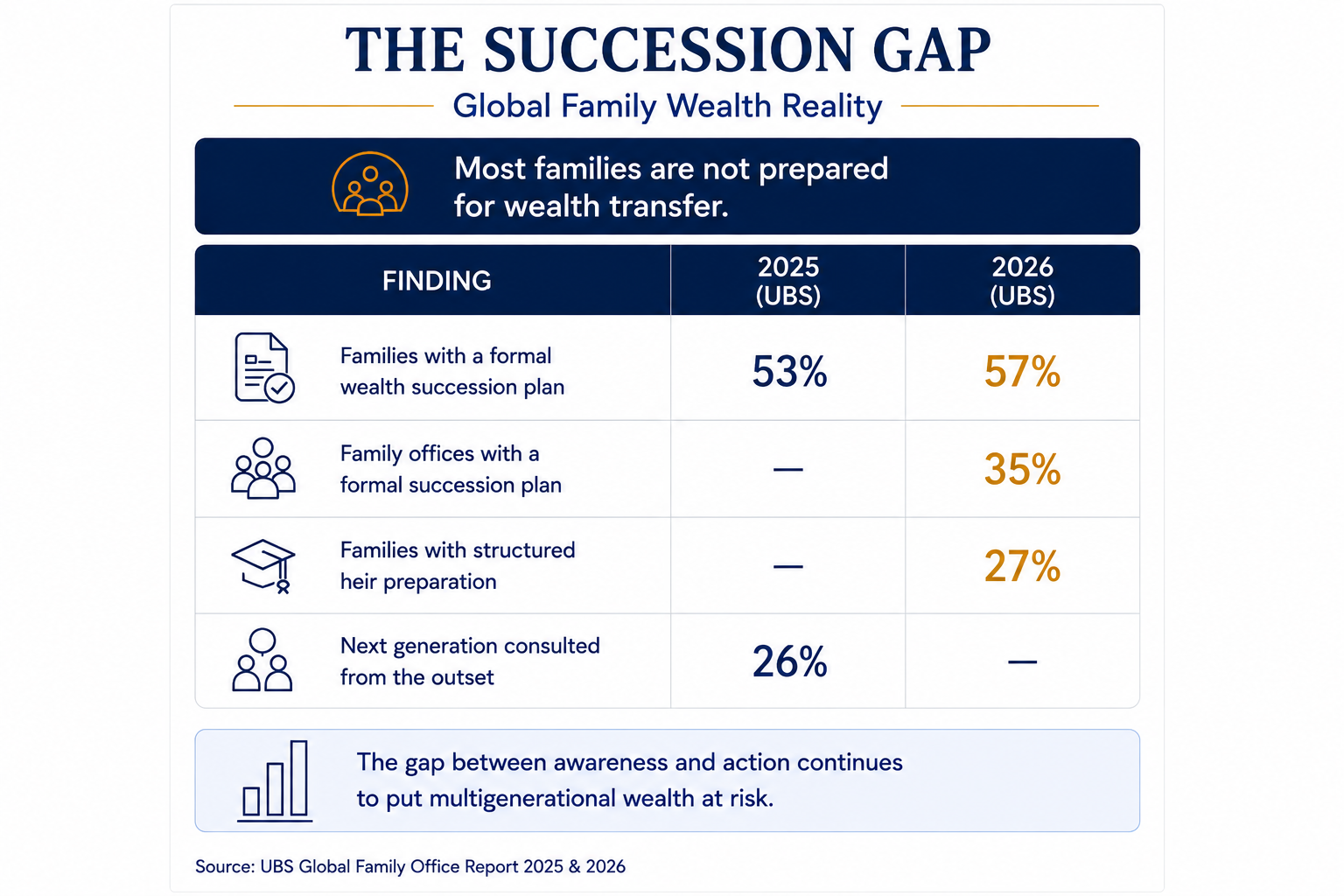
Visual 1 · The succession and heir-preparation gap
The table makes the gap visible: formal succession planning is more common than structured preparation for the next generation, while family-office succession planning itself remains limited.
HSBC’s 2025 research offers another angle for business families. Its survey of 1,798 high-net-worth Indian business owners found that 88% trusted the next generation to manage family wealth, yet 45% did not expect their children to take over the business, and only 7% of heirs felt obligated to join it. Succession, in other words, is less about who inherits the business than whether the next generation wants to run it and whether the family has built a structure that accommodates different aspirations.
Taken together, these findings point to a broader change in family wealth management. The question is no longer simply how wealth should be invested, but how it should be owned, governed, transferred and understood.
Why Inherited Wealth Erodes Over Time
Wealth does not usually disappear through one dramatic event. More often, it is gradually weakened by several forces operating at once. Each generation introduces a new set of ownership arrangements, spending requirements and decision-making preferences, and without a structure capable of adapting, the original capital can become increasingly fragmented and difficult to manage.
Fragmentation with Each Inheritance
The first source of pressure is fragmentation. Every time wealth passes to a larger number of beneficiaries, the original pool of capital may be divided into smaller pools, each with different objectives and decision-makers. For a business family, this is particularly difficult because an operating business cannot always be divided economically among its shareholders. A company built around unified ownership and decision-making may become exposed to competing priorities, disagreements over control and different attitudes towards reinvestment, dividends and risk.
The same problem exists, in a different form, for HNI families whose wealth is primarily financial. A large investment portfolio may have been created around a particular asset-allocation strategy, liquidity requirement and risk framework. Once divided among several branches, each branch may make independent decisions about how much to spend, how much risk to take and how the assets should be managed. The original advantage of scale and coordinated decision-making can gradually disappear even though the underlying assets continue to perform.
Fragmentation is therefore not simply a question of how much each heir receives. It is a question of whether the structure through which wealth is managed remains appropriate once the family becomes larger.
Consumption That Overtakes Capital Growth
The second pressure is consumption. The person who creates wealth generally spends years accumulating capital, often reinvesting business profits or returns rather than consuming them. The next generation may inherit both the capital and a lifestyle built around its existence. As the family expands, the number of people drawing on the wealth can increase even when the underlying capital does not grow at the same rate.
For business families, this can take the form of rising salaries, dividends or family expenses funded by the operating business, reducing capital available for reinvestment. For HNI families, the dynamic is more direct: if a family consistently withdraws more from its corpus than the portfolio can sustainably generate after costs and taxes, the capital will eventually decline regardless of how sophisticated the investment strategy may be.
This is why succession planning cannot be separated from cash-flow planning. A family that wants its wealth to remain intact across generations has to decide not only who will own the capital, but also how much can reasonably be consumed from it.
Heirs Who Receive Assets Before They Receive Understanding
The third pressure is the preparation gap. A person who has spent thirty years building a business or portfolio has accumulated not only capital but also experience — the risks taken, the mistakes made, the obligations attached to the assets, and the decisions to avoid. An heir may receive the same assets without any of that experience.
The UBS Global Family Office Report 2025 identified preparation of the next generation as one of the leading succession challenges among families that already had succession plans, and its 2026 report shows that only 27% of family offices have an organised process to educate and prepare the next generation for future roles and responsibilities.
The issue is not whether every heir should become an investment professional or take over the family business. It is whether the next generation understands the wealth it is expected to steward, the responsibilities attached to it and the consequences of its decisions.
The Arithmetic of Decline: How ₹10 Crore Can Change Across Generations
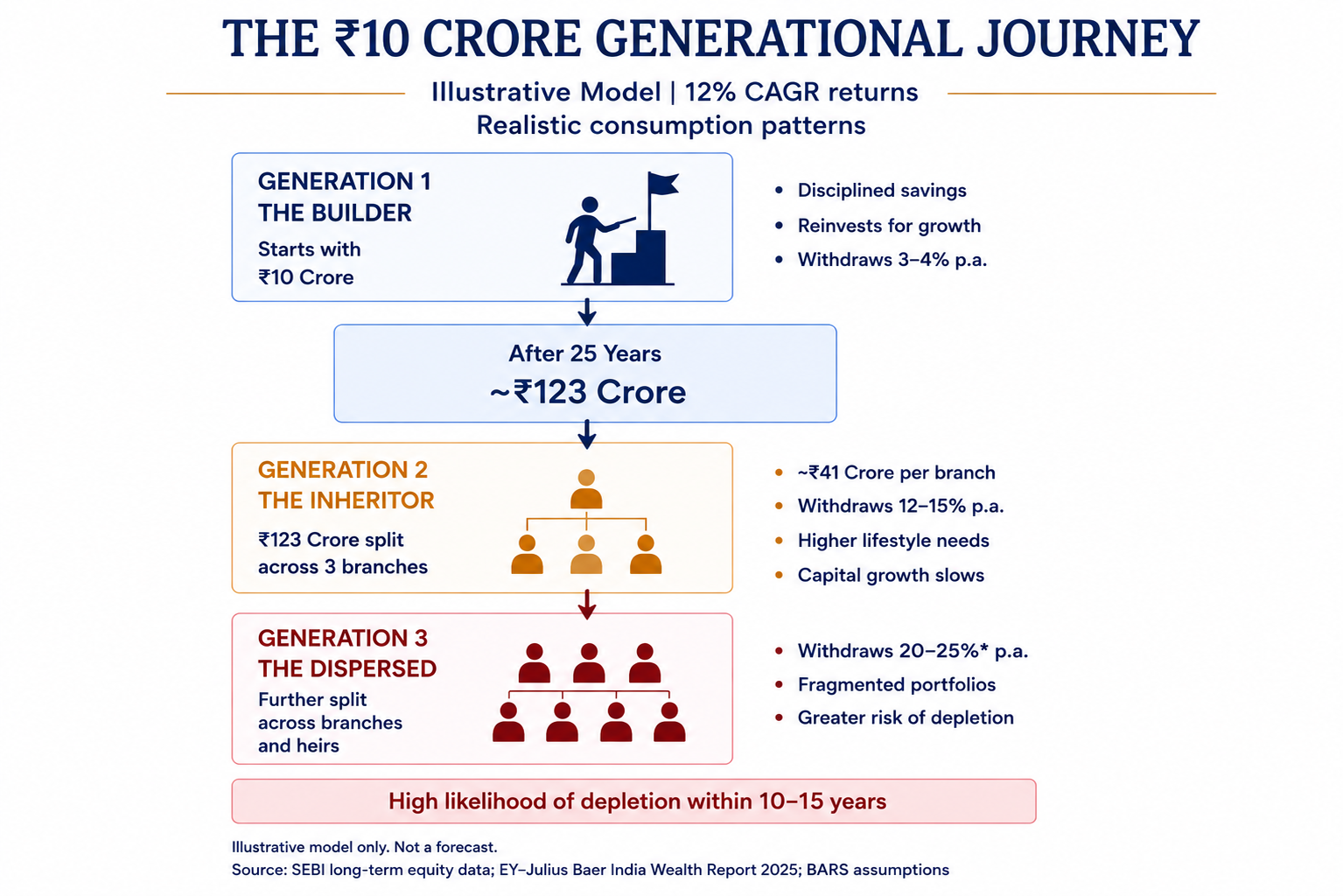
Visual 2 · Illustrative generational journey
The visual follows a simplified generational journey. A first-generation builder starts with ₹10 crore and, under the model’s assumed 12% CAGR and disciplined withdrawals, reaches approximately ₹123 crore after 25 years. The key change comes at inheritance: the corpus is then divided across three branches, so each branch starts with roughly ₹41 crore rather than one family controlling the full pool.
The next stage shows why fragmentation and consumption can change the trajectory. As withdrawals rise to roughly 12–15% a year and lifestyle needs increase, the rate at which capital is being drawn can overtake portfolio growth. The visual then shows a further split across branches and heirs, with withdrawals rising further and portfolios becoming more fragmented, increasing the risk of depletion.
This is an illustrative model, not a forecast of what will happen to a typical Indian family. The assumptions are deliberately simplified to show the mechanism: strong compounding can build substantial wealth, but fragmentation and rising withdrawals can materially change how long that wealth lasts.
Three Fractures That Can Break a Family Fortune
1. No Legal Plan for What Comes After
When a person dies without a Will, succession is governed by applicable law rather than by a document setting out the person’s wishes. For Hindus, the Hindu Succession Act, 1956 codifies rules on intestate succession and also addresses testamentary succession; the Indian Succession Act, 1925 consolidates law on intestate and testamentary succession where it applies. The precise law depends on personal circumstances, religion, domicile, the nature of the assets and other legal considerations.
For a family with a substantial operating business, this can matter a great deal. Equal legal entitlement does not necessarily create an economically sensible ownership structure for an operating company. One family member may want to keep running the business, another may want liquidity, and another may have no interest in participating at all — and without a clear succession framework, these competing interests can become a source of prolonged disagreement.
For an HNI family, the same issue arises across financial assets and real estate. A portfolio designed as a single investment strategy may become divided among beneficiaries with different financial needs, risk tolerances and levels of experience. A Will cannot solve every family disagreement, but it can state the owner’s intentions clearly and form one part of a broader succession framework.
2. Consumption Exceeding Capital Growth
As families expand across generations and branches, total annual withdrawals from the corpus can grow continuously while the corpus itself may not keep pace. For business families, this may appear as growing personal drawings, dividends and family expenses charged to the operating business, reducing capital available for reinvestment and competitive positioning. For HNI families, the dynamic is more direct: lifestyle spending from an investment corpus can exceed portfolio returns, and with each additional branch the withdrawal pressure multiplies.
3. Transferring Wealth Faster Than Financial Judgment
The preparation gap between what heirs receive and what they understand can be one of the most preventable risks in wealth transfer. For business families, an unprepared heir inheriting a leadership position can affect key employees, customer relationships and institutional knowledge. For HNI families, an heir receiving a large liquid portfolio without financial judgment may make poor investment decisions, overspend, or take risks the previous generation never would have.
The solution is not to prevent the next generation from receiving wealth. It is to ensure that responsibility develops alongside capability.
The Reliance Succession: A Lesson in the Cost of Unclear Succession
The succession dispute that followed Dhirubhai Ambani’s death in 2002 remains one of India’s most prominent examples of what can happen when a founder’s death is followed by disagreement over ownership and control. Mukesh and Anil Ambani eventually reached a settlement in 2005 under which the businesses were divided between them.
It would be too simplistic to attribute the two groups’ subsequent history solely to the absence of a Will as the dispute involved complex questions of ownership, management, strategy and family relationships. The more useful lesson is that when ownership, management authority and succession expectations are not clearly addressed in advance, a transition can consume significant time and attention and create uncertainty for the business as well as the family.
A comprehensive succession plan should therefore look beyond who receives what. It should consider who will own the assets, who will manage them, how important decisions will be taken, how family members who want liquidity can be accommodated, and what mechanisms apply if members disagree.
A Nomination Is Not a Substitute for a Succession Plan
Nominations are another area where families frequently confuse administrative convenience with succession planning. A nomination matters because it lets financial institutions identify who is entitled to claim assets after an account holder or investor dies, and SEBI has continued to revise and simplify this framework for demat accounts and mutual-fund folios, most recently with modified nomination norms issued in May 2026.
However, a nomination should not be treated as a replacement for a Will or a comprehensive estate plan. SEBI’s transmission framework specifically addresses how securities move from a nominee to the legal heir, reinforcing the distinction between the administrative process of transmission and the broader question of succession.
For families with substantial assets, nominations, ownership records, Wills and any trust structures should therefore be reviewed together. A nomination can smooth the transmission process, but it does not by itself create the broader framework through which a family decides how its wealth should be owned and governed.
Building a Structure That Outlasts Its Creator: The Private Family Trust
A private family trust can provide a longer-term framework for holding and administering assets according to a trust deed. The Indian Trusts Act, 1882 defines the law relating to private trusts and trustees, covering the creation of trusts, trustee duties and liabilities, trustee powers and beneficiary rights.
The purpose of a family trust is therefore not simply to avoid a particular administrative process after death. Properly structured, it can let a family set rules around ownership, management, distributions and succession that continue to operate according to the trust deed and, depending on the structure, provide a framework for different generations and beneficiary needs over time.
The legal and tax consequences of a trust depend heavily on its structure, the assets transferred, the beneficiaries, the powers retained by the settlor and the circumstances of creation. Questions of revocability, creditor protection, taxation and succession should therefore be evaluated individually rather than treated as automatic benefits of every family trust.
The important distinction is that a Will primarily expresses testamentary intent, whereas a trust can create an ongoing framework for the ownership and administration of assets that have actually been transferred into the trust.
The Tata Structure: Continuity Through Ownership, but Not Without Governance Challenges
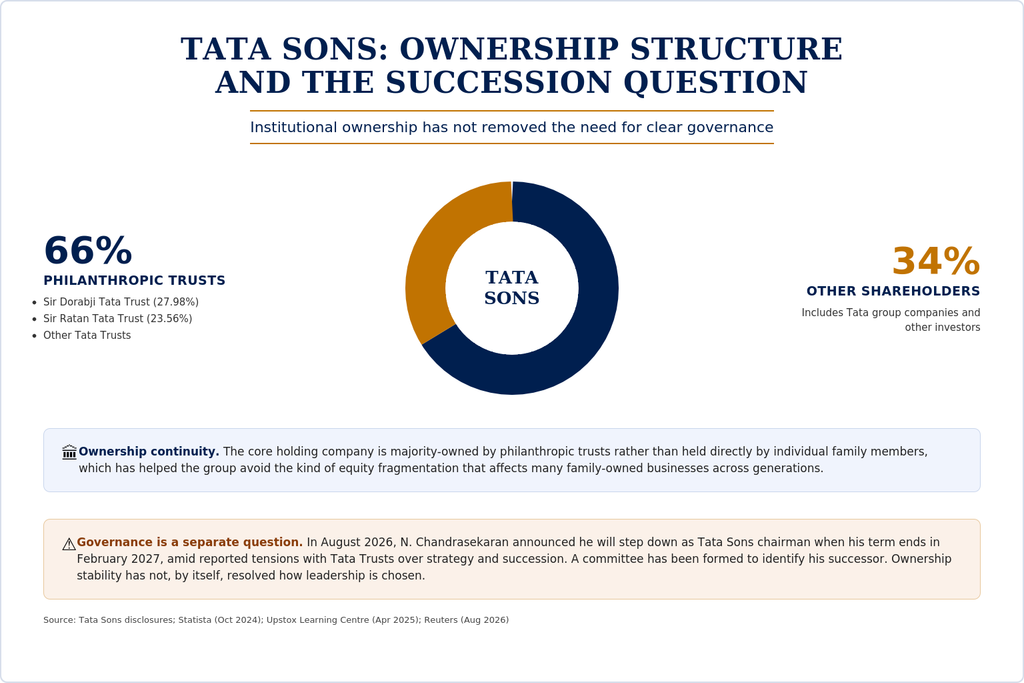
Visual 3 · Tata Sons ownership structure
The Tata Group is an interesting example of how ownership structure can influence long-term institutional continuity. Tata states that 66% of the equity share capital of Tata Sons, its principal investment holding company, is held by philanthropic trusts, meaning the core holding company is not simply an asset that can be divided among individual family members the way a conventional family estate can.
That structure has contributed to the group’s continuity across generations, but it should not be read as evidence that a trust structure eliminates succession or governance problems. The events of August 2026 show precisely why the distinction matters: N. Chandrasekaran has announced he will step down as chairman of Tata Sons when his term ends in February 2027, amid tensions with Tata Trusts, which controls 66% of Tata Sons. A committee has been formed to identify his successor, bringing the relationship between ownership, governance and professional management back into focus.
The lesson is not that Tata represents flawless succession. A strong ownership structure can help prevent fragmentation of the underlying institution, but ownership continuity does not automatically guarantee management continuity because an institution can have a carefully designed ownership structure and still require clear processes for selecting leaders, resolving disagreements and maintaining governance.
How a Trust Differs from a Will
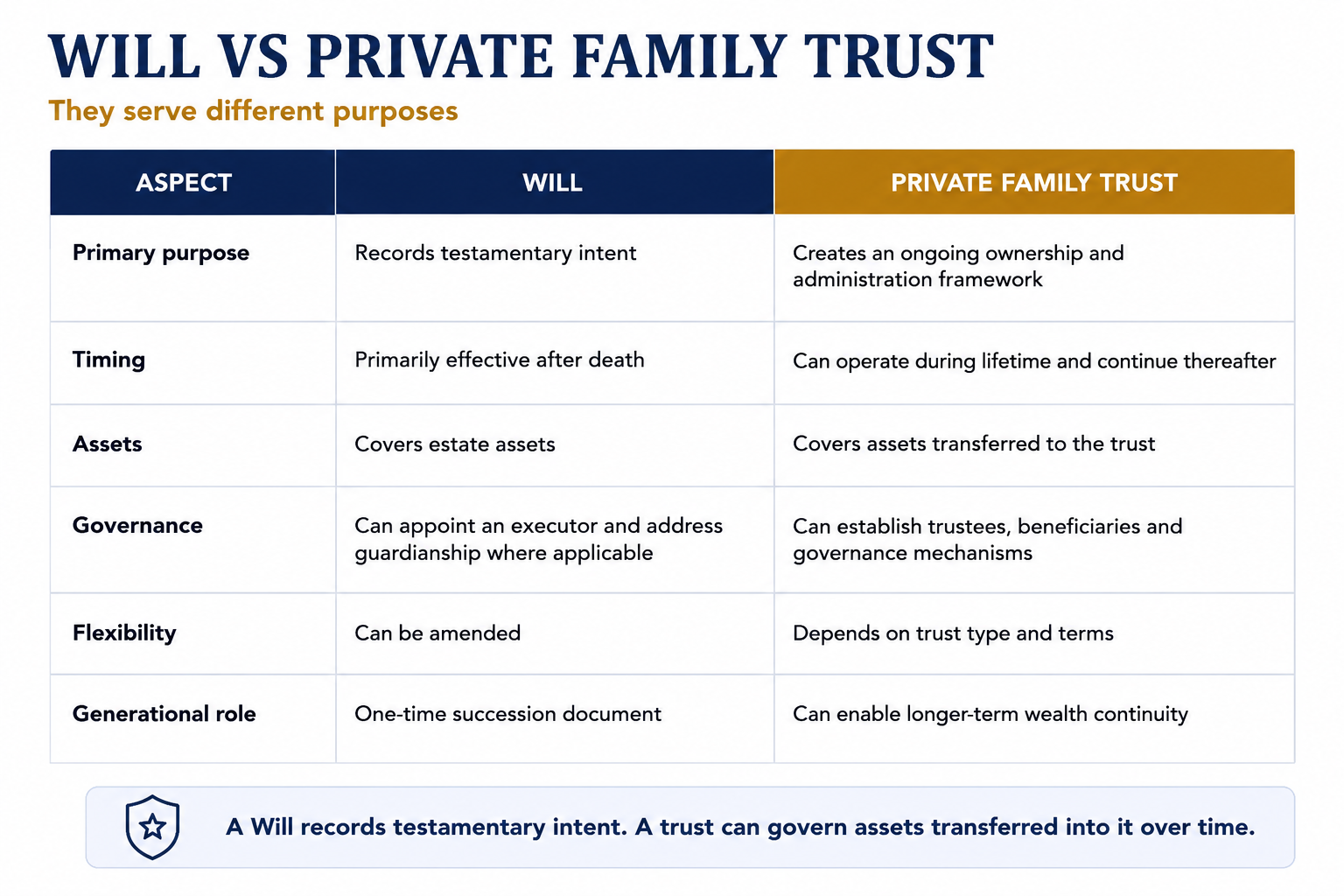
Visual 4 · Will versus private family trust
India’s Wealth-Transfer Gap
The growth of India’s family-office ecosystem reflects a broader shift in how wealthy families think about managing capital. The EY–Julius Baer Indian Family Office Playbook notes that family offices have expanded from approximately 45 in 2018 to around 300 in 2024, while their responsibilities have broadened beyond investment management to include wealth preservation, succession planning, governance and philanthropy.
The same study found that 59% of surveyed family offices had implemented wills or constitutions, whereas only 19% had adopted formal structures such as trusts or LLPs. These figures describe the surveyed family-office population rather than all Indian wealthy families, but they illustrate an important distinction: documenting family intentions and creating a formal legal structure are not the same thing.
The scale of the coming transition makes this increasingly relevant. The study points to a substantial intergenerational transfer involving businesses, investment portfolios, real estate, private assets and family structures, each of which can require a different form of succession planning.
Cultivating Capable Heirs: The Role of Financial Education
A Will can document intentions and a trust can provide a structure for holding and administering wealth, but neither guarantees that the people who eventually inherit it will be capable of managing it. This is where financial education and deliberate preparation of the next generation become essential.
The UBS Global Family Office Report 2026 found that only 27% of surveyed family offices have an organised process to prepare the next generation for future roles, though 45% involve the next generation to some extent. A meaningful proportion of heirs old enough to participate remain uninvolved. UBS reports that family offices most commonly see ages 18–29 as the period for preparation and education, and 30–39 as the period for greater involvement in decisions.
For business families, this preparation can determine whether the next generation is ready to manage the operating business or whether professional management may be more appropriate.
What Heir Preparation Actually Means
Financial education should therefore begin well before inheritance. Children and young adults can gradually be introduced to concepts such as compounding, risk, diversification, taxation and the history of how the family created its wealth, and as they mature, invited to observe and eventually participate in investment or family-governance discussions.
For business families, external work experience can be particularly valuable. Working in an unrelated organisation lets the next generation develop professional judgment somewhere performance is measured independently and responsibility has to be earned rather than assumed through family position.
When an heir eventually enters the family business, structured progression can be more useful than immediate authority. Experience across functions such as finance, operations, procurement or client management builds an understanding of how the business actually works before the individual assumes senior responsibility; for a family office, a similar progression might move from observation to analysis to decision-making.
The objective is not to control the next generation indefinitely. It is to ensure that responsibility grows alongside capability.
Building Family Governance Alongside Legal Structures
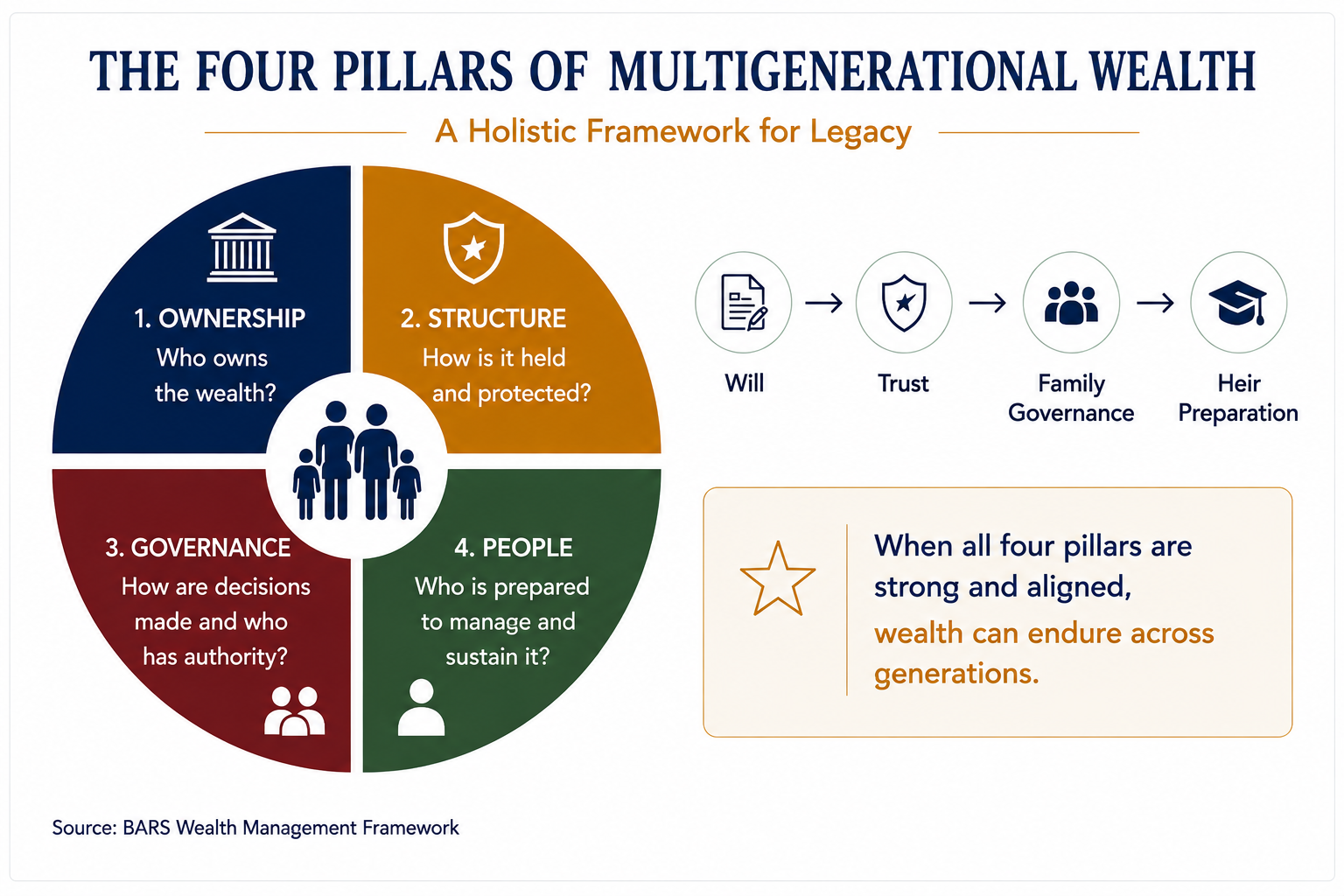
Visual 5 · Four pillars of multigenerational wealth
For larger families, the legal structure is only one part of the succession framework. A family constitution or governance framework can establish principles around ownership, employment in the family business, decision-making, conflict resolution, family meetings, next-generation participation and philanthropy.
This becomes particularly important once ownership and management are no longer concentrated in the same hands. A family member may be an economic owner without being a manager; another may manage the business without owning a controlling stake; a third may want to exit and receive liquidity. Without an agreed framework, each situation can become a source of disagreement.
A useful succession framework therefore needs to answer several questions. A Will addresses testamentary intentions. A trust can establish rules around assets transferred into it. A shareholder or buy-sell agreement can address business ownership and exit arrangements. A family governance framework establishes how the family makes decisions, and financial education prepares the next generation to participate responsibly in that system..
Matching the Structure to the Situation
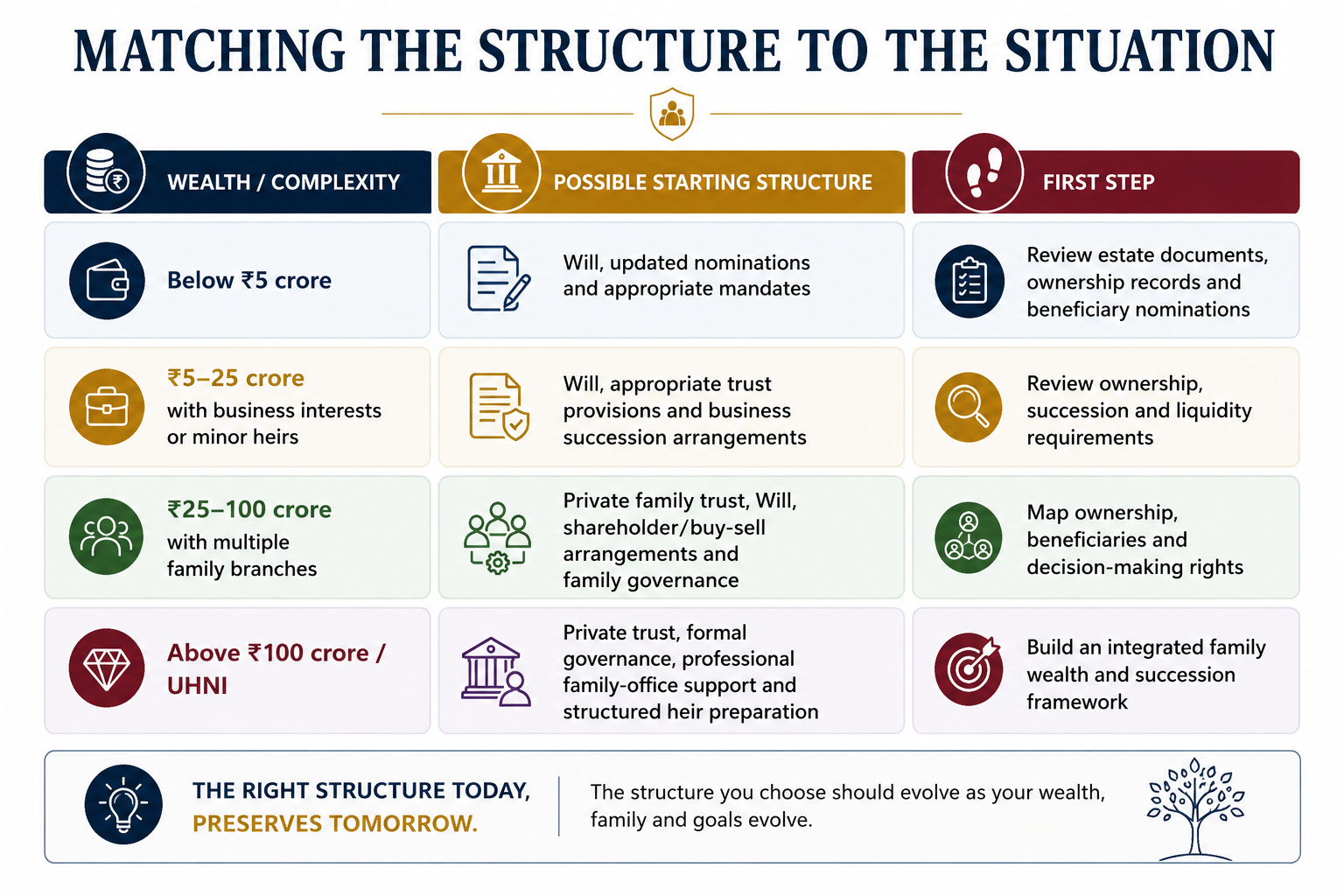
Visual 6 · Matching structure to situation
There is no universal wealth threshold at which every family should establish a trust or family office. The appropriate structure depends on the nature of the assets, the number of beneficiaries, the presence of a family business, the age and preparedness of heirs, the family’s governance requirements and the legal and tax circumstances involved. The figures above should therefore be treated as an illustration, not as legal or tax thresholds or recommendations.
The Way Out
We opened with a simple question: if you spent a lifetime building ₹10 crore today, what would determine whether that wealth was still intact and working 60 years from now?
The answer is not simply a portfolio that earns a good return. The wealth has to move from one generation to the next without losing its purpose, its structure or the discipline with which it was created. And that requires planning for ownership as well as investment, consumption as well as returns, and the people who will inherit the wealth as well as the assets themselves.
The Will records the founder’s intentions. A trust, where appropriate, can create a longer-term framework for assets transferred into it. Business succession arrangements can address ownership and management continuity. Family governance can provide a process for decision-making as the family becomes larger and more complex, and financial education can ensure the next generation does not receive substantial responsibility without first developing the judgment required to exercise it.
India is approaching a significant intergenerational transfer of wealth, while UBS research continues to show that even among the world’s wealthiest families, succession planning and next-generation preparation remain incomplete.
The families that preserve wealth across generations will not necessarily be the ones with the highest investment returns. They are more likely to be the ones that recognise early enough that wealth needs an architecture around it: clear ownership, thoughtful succession, appropriate governance and a next generation prepared to carry that responsibility.
The best time to build that structure is before it is needed. The second best time is now.
References and Sources
1. EY–Julius Baer, The Indian Family Office Playbook, 2025. Used for the Indian family-office growth, wills/constitutions, formal structures and US$1.5 trillion wealth-transfer estimates.
2. UBS, Global Family Office Report 2025. Used for the 53%, 43% and 26% succession statistics and the 317-family-office sample.
3. UBS, Global Family Office Report 2026. Used for the 57%, 35% and 27% succession and heir-preparation statistics, sample size and next-generation preparation age ranges.
4. Government of India, India Code — Hindu Succession Act, 1956. Used for the legal discussion of intestate and testamentary succession.
5. Government of India, India Code — Indian Succession Act, 1925. Used for the legal discussion of succession.
6. SEBI, Modified Norms for Nomination in Demat Accounts and Mutual Fund Folios, May 2026. Used for the updated nomination framework.
7. SEBI, Smooth Transmission of Securities from Nominee to Legal Heir, September 2025. Used for the nominee-to-legal-heir transmission discussion.
8. Government of India, India Code — Indian Trusts Act, 1882. Used for the private family trust discussion.
9. Tata Group / Tata Sons. Used for the 66% Tata Sons equity ownership held by philanthropic trusts.
10. Reuters, August 18, 2026. Used for the current Tata Sons chairman succession and governance developments.
11. HSBC Global Private Banking, Harmony Through Succession Planning, 2025. Used for the Indian family-business succession findings.
12. BARS Wealth. The ₹10 crore generational model is an illustrative mathematical scenario, not an external statistic.