
Compounding is often described as the most powerful force in wealth creation. What receives far less attention is that the same force can quietly erode wealth when inflation, taxes, fees, and poor decisions are left to run unchecked.
Albert Einstein is often credited with calling compound interest the eighth wonder of the world. Whether he actually said those words remains a matter of debate, but the phrase has survived because it captures something true. Few concepts have had a greater influence on the financial outcomes of individuals, families, and entire portfolios than compounding.
Yet for all the attention it receives, compounding remains surprisingly misunderstood.
Most investors recognise it as something positive. Money invested today has the potential to become a larger amount tomorrow. What is less widely understood is that compounding is not simply an investment concept. It is a mathematical force that shapes almost every aspect of financial life. It determines how wealth accumulates, how purchasing power declines, how portfolio costs affect long-term returns, and why seemingly small decisions can have consequences that become enormous over time.
The challenge is that compounding rarely feels significant when it begins. In its early years, progress appears modest. Growth seems incremental. Only later does its true power become visible, when years of accumulated growth begin generating growth of their own. By the time most investors fully appreciate this, they often realise that their greatest asset was never a particular stock or fund. It was time. Before understanding how compounding can erode wealth in reverse, we must first see why its exponential nature makes both outcomes so dramatic.
Why Compounding Feels Counterintuitive
One reason compounding is so frequently underestimated is that it behaves differently from the way most people instinctively think about growth. Human beings are naturally accustomed to linear relationships. If a business grows by Rs. 10 lakh this year, we assume next year’s growth will look broadly similar. If a salary increases steadily throughout a career, we expect future increases to follow a comparable pattern.
Compounding follows an entirely different path. Instead of growing in a straight line, wealth grows exponentially when returns are continuously reinvested. Each year’s gains become part of the capital base that generates future returns. The result is a pattern that appears slow and unimpressive in its early stages but becomes remarkably powerful over longer periods.
Consider an investor who places Rs. 50 lakh into an investment earning 10 percent annually and allows the returns to remain invested.
The more important observation here is not the final number but where the wealth was actually created. During the first decade, the portfolio grew by approximately Rs. 80 lakh. During the second decade, it added more than Rs. 2 crore. During the third decade, it added over Rs. 5 crore. Nothing about the investment changes as the return remains the same and the investor does nothing differently. The only variable that changes is the length of time the money remains invested.
This is why experienced investors speak about time with such emphasis. In wealth creation, time is not merely an input. It is the multiplier that amplifies every other decision.
Small Differences in Return, Large Differences in Outcome
Investors frequently spend considerable energy debating whether a portfolio should earn 8, 10, or 12 percent annually. Viewed over a single year, these differences appear modest. Viewed over several decades, they become transformational.
Rs. 50 lakh invested for 30 years
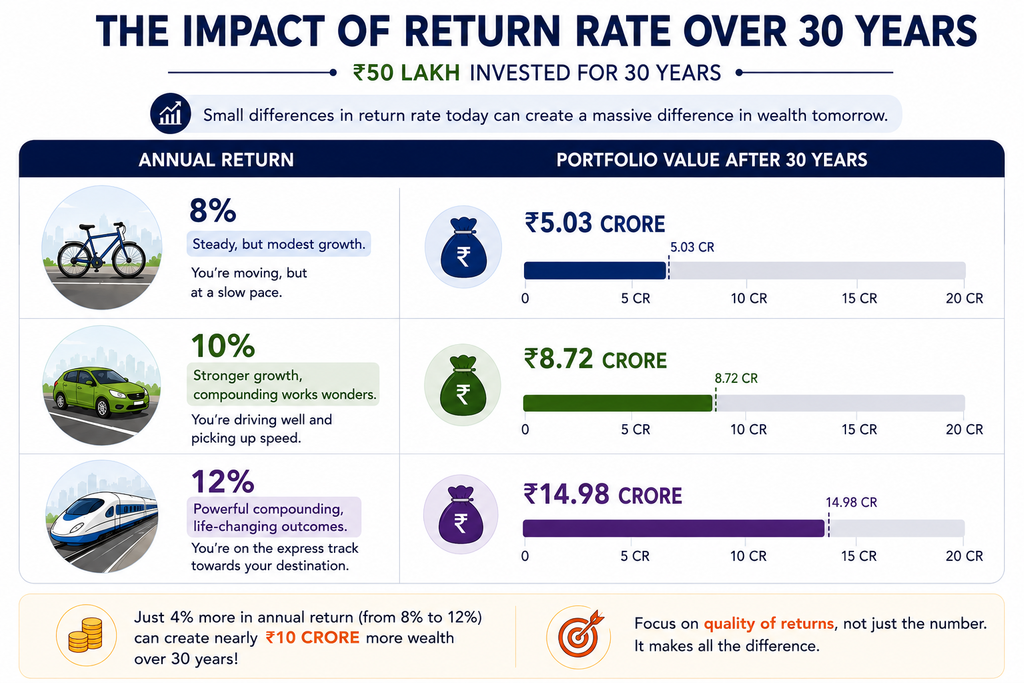
The difference between an 8 and 12 percent return is only four percentage points. Over thirty years, that gap results in nearly Rs. 10 crore of additional wealth.
This is why asset allocation, portfolio efficiency, tax management, and cost control matter as much as they do. These are often treated as technical details, but they directly influence the rate at which compounding operates. Small improvements in efficiency may appear insignificant today. Their cumulative effect over decades can be substantial.
The goal is not to chase the highest possible return. It is to build a portfolio structure capable of generating consistent returns while minimising unnecessary friction along the way.
The Story That Explains Compounding Better Than Any Formula
Financial concepts are often easier to understand through people than through numbers. Imagine two investors – Arjun and Priya.
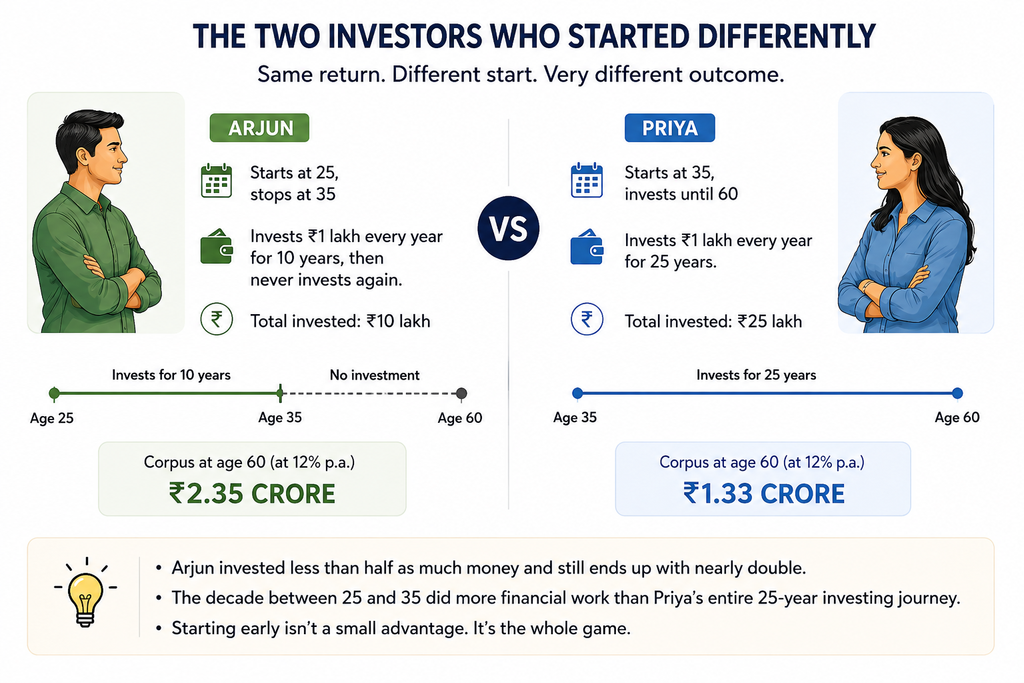
The explanation lies in the decade between twenty-five and thirty-five. Those years allowed compounding to begin earlier, creating a foundation that continued generating returns for decades thereafter. The lesson is not that Priya did something wrong. It is that compounding rewards time more generously than it rewards effort.
The Side That Rarely Gets Discussed
Much of the financial industry’s conversation around compounding focuses on wealth creation. What is less often discussed is that compounding itself has no preference. It applies its logic consistently to whatever it touches. The same force that helps a portfolio grow also works against investors when the following factors are allowed to run unchecked:
Inflation. At a steady 5%, purchasing power effectively halves roughly every fourteen years. An investor focused only on nominal portfolio growth may feel wealthier on paper while experiencing little real improvement.
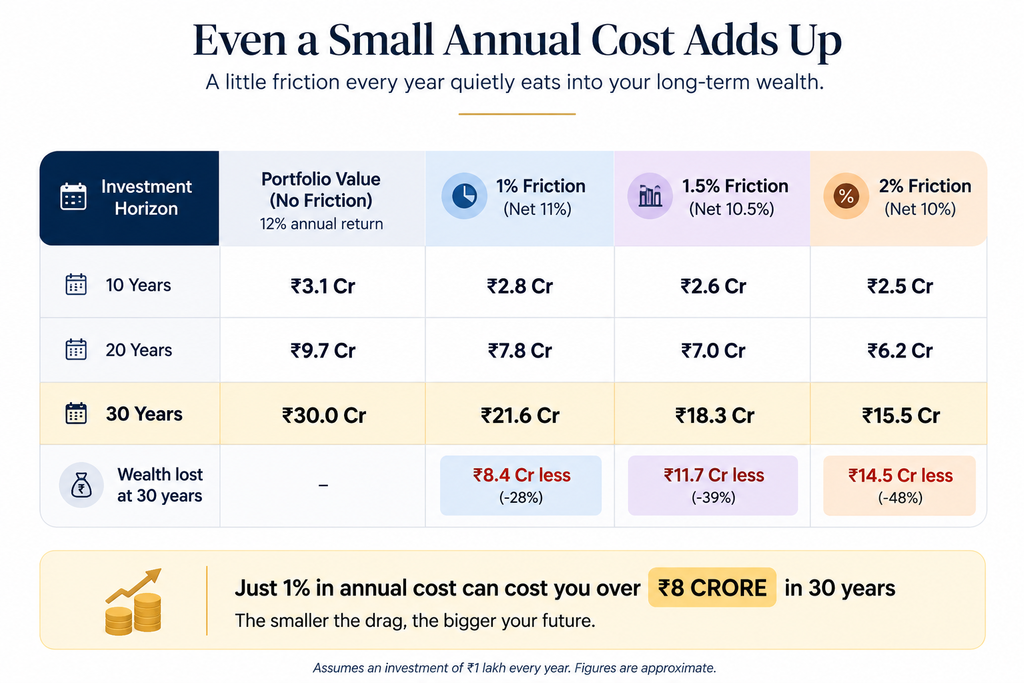
Fees and Taxes. Even relatively small annual fees and expenses can materially reduce long-term wealth because they reduce the amount of capital that remains invested and compounding. Taxes and transaction costs can add further friction depending on the investment, transaction, and investor circumstances. The real cost is not simply the amount paid today; it is also the future compounding that money could otherwise have generated.
Behaviour. Panic selling during corrections often feels rational in the moment. Yet investors who repeatedly exit and re-enter markets can damage long-term wealth by missing periods of strong market performance. Historical market research shows that missing a relatively small number of the market’s strongest trading days can materially reduce long-term returns, although the exact impact depends on the market and period studied.
Compounding does not distinguish between positive and negative influences. It simply magnifies them.
What This Means for High-Net-Worth Families
For affluent families, the conversation around compounding evolves beyond wealth creation toward wealth preservation. The challenge is no longer how to build from scratch. It becomes ensuring that substantial wealth continues compounding efficiently across decades and, ideally, across generations.
In practice, the greatest threats at this stage are rarely dramatic. They take the form of seemingly ordinary decisions, such as
- Excessive cash sitting idle while waiting for the right opportunity.
- Frequent portfolio restructuring that creates unnecessary tax friction.
- Concentrated positions that increase risk without proportionate reward.
- Estate structures that fail to preserve accumulated wealth effectively during transfer.
Each of these introduces friction into the compounding process.
A remarkable proportion of Warren Buffett’s wealth was accumulated later in his life, after decades of investing and compounding. Not because he suddenly became a better investor later in life, but because compounding had been running uninterrupted for decades by then. The lesson is not to be Warren Buffett. It is to recognise that time and consistency do work that no single investment decision can replicate.
Successful wealth management is therefore rarely about finding the next opportunity. More often, it involves protecting an existing compounding engine from the factors that quietly erode its effectiveness.
Three Things Worth Getting Right
Stay invested whenever appropriate. Constant activity is frequently mistaken for prudent portfolio management. Unnecessary exits can interrupt the compounding process, particularly when investors remain out of the market or incur avoidable taxes and costs. Selling decisions should be driven by factors such as a change in the investment case, portfolio risk, financial goals, liquidity needs, tax considerations, or other relevant circumstances.
Pay attention to costs and taxes. Every rupee unnecessarily lost today is not merely a rupee gone. It is a rupee that can no longer generate future returns. Review your portfolio’s total cost structure regularly and consider the tax consequences of redemptions and portfolio changes before acting, while taking account of the rules applicable to your circumstances.
Do not wait for the perfect moment. Capital sitting uninvested in search of certainty is not standing still. Inflation can reduce its purchasing power while time spent out of the market can reduce the opportunity for long-term compounding. Markets have never offered perfect clarity and they never will. Investors who benefit from compounding generally focus on a suitable long-term plan rather than waiting for ideal conditions.
Closing Thought
Compounding is often presented as a financial strategy. It is better understood as a fundamental law governing how wealth evolves over time. Whether we recognise it or not, it is already shaping our financial future. The only question is whether it is working in our favour or against us.
The investors who build enduring wealth are not necessarily those who discover extraordinary opportunities or make bold calls. More often, they are those who understand the value of time, avoid unnecessary interruptions, and allow their capital to remain invested long enough for compounding to do what it does best.
In the end, great fortunes are rarely built through brilliance alone. They are built through patience, discipline, and the willingness to let time do what no investor can accomplish on their own.
References and factual notes
SEBI Investor Education, Financial Education Part A
https://www.sebi.gov.in/sebi_data/investors/financial_literacy/Financial%20Education%20Part%20A.pdf
Supports the explanations of inflation, real returns and the power of compounding.
U.S. SEC / Investor.gov, How Fees and Expenses Affect Your Investment Portfolio
https://www.investor.gov/introduction-investing/general-resources/news-alerts/alerts-bulletins/investor-bulletins/updated
Supports the claim that even relatively small fees and expenses can materially reduce long-term portfolio value.
CFA Institute, Lessons from Capital Market History
https://rpc.cfainstitute.org/research/cfa-magazine/2016/lessons-from-capital-market-history-expanded
Supports the discussion of the opportunity cost of missing the strongest market days and the difficulty of market timing.
CFA UK, Foreword from the Chief Executive
https://www.cfauk.org/-/media/files/pdf/pdf/5-professionalism/3-research-and-position-papers/negative-rates-and-negative-interest-rates-policy—2020.pdf
Supports the statement that the Einstein compound-interest attribution is disputed and likely an urban myth.
Editorial note: The numerical illustrations in this article assume a constant annual return with returns reinvested and are illustrative rather than forecasts. Actual investment returns vary over time and taxes, fees, and costs can affect outcomes.