
There’s a point where a portfolio simply outgrows the structure it started in. Most investors never reach it, and most never need to. But for the ones who do, it’s worth knowing what that point actually looks like, because the number people fixate on isn’t the one that matters.
Mutual funds are one of the most effective ways to access professionally managed, diversified portfolios without having to pick and monitor individual securities yourself. For most people, that’s the right tool for the entire length of their investing life. Nothing about this article changes that.
But wealth doesn’t stay simple forever. Add a few funds every year, a block of shares from an inheritance or an employer, some direct equity you bought on a tip a decade ago, and eventually different parts of your money are being managed by different people who have no idea what the others are doing. At that stage, the question stops being “which is a good fund” and becomes “is my portfolio being managed as one thing, or as five unrelated things that happen to share my name.”
PMS isn’t an upgrade from a mutual fund. It’s a different structure, built to solve that second problem. Whether it’s worth the switch depends entirely on which problem you actually have.
What PMS actually is, mechanically
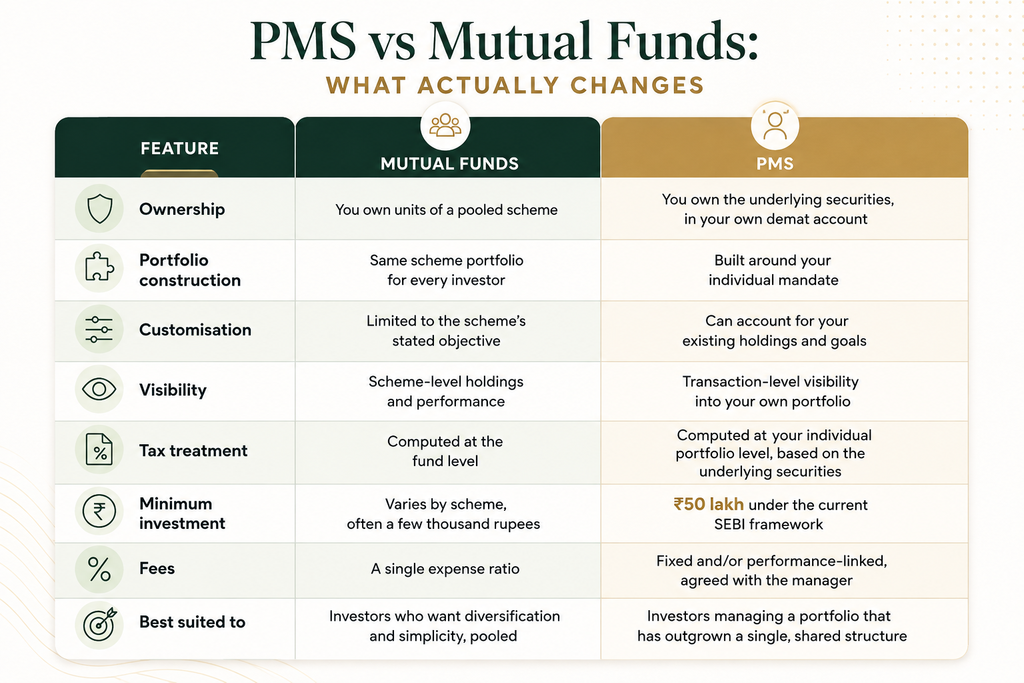
Portfolio Management Services is a SEBI-regulated arrangement where a portfolio manager runs a portfolio built specifically around you, holding the underlying securities directly in your own demat account. A mutual fund pools your money with everyone else’s and runs one shared scheme. PMS builds one portfolio, and it’s yours alone.
It comes in two forms. In a discretionary PMS, the manager makes the calls within your agreed mandate. In a non-discretionary PMS, the manager recommends and you approve every transaction yourself. The difference matters, because it decides how much control you’re actually handing over.
The real advantage is customisation, not size
Say you already hold a large position in one company through a business interest or an early investment. A mutual fund has no way to account for that. The fund manager runs the scheme for every investor in it and can’t quietly skip a stock because one particular investor already owns too much of it elsewhere.
A PMS portfolio can be built to take your existing exposure into account, within the mandate and the applicable rules. That’s the actual value on offer: not a bigger portfolio, a portfolio that knows what else you own. The same logic applies to specific liquidity needs, legacy holdings, or a preference to stay under a certain concentration in any one sector. The goal is coordination, not customisation for its own sake.
Visibility works differently too
With a mutual fund, you see the scheme’s holdings and performance, not the individual trades happening inside it. With PMS, you see your own portfolio at the transaction level, because it’s held in your own account. SEBI’s investor guidance is direct about this: check your demat holdings and transaction records regularly, and know exactly what authority you’ve handed to your portfolio manager.
For a straightforward portfolio, that level of detail is more than most people want or need. For a large, layered one, it’s often the whole point.
Is ₹50 lakh the line?
No. It’s the entry ticket, not the signal. Under the current PMS framework, ₹50 lakh is the regulatory minimum, and individual providers are free to set it higher for a given product. That threshold has moved before too, SEBI doubled it from ₹25 lakh to ₹50 lakh in 2020, specifically to keep the category limited to investors who can absorb the risk that comes with a concentrated, directly-held portfolio.
An investor with ₹75 lakh spread across a handful of diversified funds may be perfectly well served staying exactly where they are. Someone with a smaller total but a genuinely complex mix of legacy holdings, concentrated positions, and tax considerations may have more to gain from a coordinated structure. The number tells you when PMS becomes accessible. It doesn’t tell you whether you need it.
The cost and tax difference
PMS fees are agreed directly with the portfolio manager, and they typically run higher than a mutual fund’s expense ratio, sometimes a fixed fee, sometimes a fixed fee plus a performance fee above a high-water mark. Customisation and coordination cost more to deliver than a shared scheme does. That’s not a hidden catch, it’s the trade you’re making, and it’s worth weighing against what you’re actually getting for it rather than against the headline return alone.
Taxation changes too. Because you hold the securities directly, gains and losses sit in your own hands and are taxed the way direct equity is taxed, computed transaction by transaction, rather than absorbed inside a fund’s own tax treatment. That gives you more control over timing. It also means more to track. Your tax professionals will need full transaction records, not a single fund statement at year end.
A newer middle ground: Specialised Investment Funds
Before assuming the choice is mutual fund or PMS, it’s worth knowing about a third category. SEBI introduced Specialised Investment Funds, or SIFs, within the mutual fund framework, for strategies more specialised than a typical scheme allows. The minimum across an SIF’s strategies is ₹10 lakh, well below the PMS threshold.
SIFs keep the pooled structure of a mutual fund. They don’t offer the individual-level customisation PMS does. But they sit in a genuinely useful middle space for a portfolio that has outgrown a plain mutual fund without needing the full ₹50 lakh commitment PMS requires.
What’s changing: a proposed MF-only PMS category
In July 2026, SEBI released a consultation paper proposing a separate MF-only PMS category, where a portfolio manager runs client money exclusively in direct plans of mutual funds, ETFs, and SIFs, at a proposed minimum of ₹25 lakh instead of ₹50 lakh. This is a proposal under public consultation. It is not the current PMS framework, and ₹25 lakh is not a live entry point today.
The proposal matters because it names a real gap: investors who want professional, coordinated fund selection without moving into a full PMS built around individual securities. Worth tracking as it develops. Not worth acting on yet.
The industry is growing, which tells you demand exists, not that you need it
PMS assets under management stood at roughly ₹44.11 lakh crore as of July 31, 2026, according to SEBI data drawn from 514 reporting entities that month. The number of registered portfolio managers has grown from 226 in 2020 to 514 today. SEBI’s own July 2026 consultation paper cites this growth as one reason for reviewing the regulatory framework.
That growth says something about the market. It says nothing about your specific portfolio. Plenty of investors with PMS-eligible wealth are still, correctly, sitting in mutual funds.
PORTFOLIO CHECK
- How much exposure do I actually have to one company or sector, once I add up everything I hold, not just what’s in any single fund?
- Am I paying for the same stocks or themes twice, through overlapping funds?
- Should my existing holdings be shaping the investments I make today, and are they?
- Which positions should I be holding, reducing, or exiting, in the context of everything else I own?
- Do my investments actually match my current liquidity needs and goals, or the goals I had when I first bought them?
- Would seeing my portfolio at the transaction level change how I feel about what I own?
These aren’t questions a fund fact sheet answers. They’re questions about the whole portfolio, and as wealth grows more complex, the way it’s managed has to keep pace with it.
The real question was never “should I move to PMS.” It’s whether your portfolio is still being managed in a way that reflects the person who actually owns it, or whether it’s become a pile of decisions made at different times, for different reasons, that have never once been looked at together.
If you’re not sure which side of that line you’re on, that’s exactly what a Portfolio Wealth Review is for. Start with a Portfolio Wealth Review.
SOURCES
- SEBI Investor Charter — Portfolio Management Services — investor.sebi.gov.in
- SEBI, Consultation Paper on Comprehensive Review of SEBI (Portfolio Managers) Regulations, 2020, July 2026 — sebi.gov.in
- SEBI, Assets Managed by Portfolio Managers, July 31, 2026 — sebi.gov.in
- SEBI, Specialised Investment Fund framework — sebi.gov.in
Bars Wealth operates under Catcon Capital Private Limited (AMFI-registered ARN-334186, APMI-registered). This article shares general observations on Portfolio Management Services and is not investment advice or a recommendation to invest in any specific product. PMS investments carry market risk, including the risk of capital loss. Please speak with your Research Analyst and your tax professionals before making any investment decision. Regulatory thresholds mentioned above reflect the position as of the publication date and are subject to change by SEBI.