
What is a Mutual Fund?
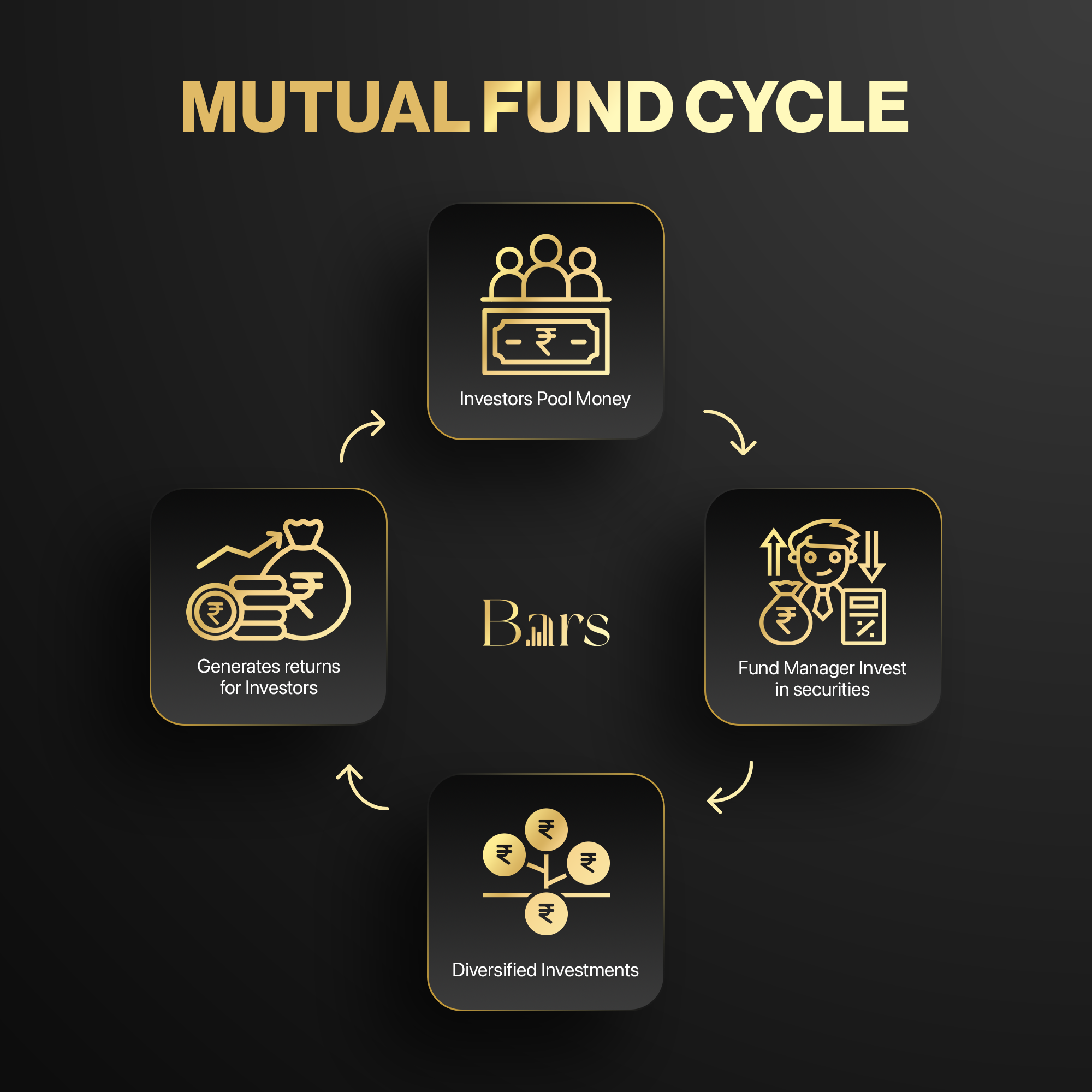
A mutual fund is an investment vehicle that pools money from many investors to invest in a diversified portfolio of securities like stocks and bonds, managed by a professional fund manager. Each investor owns units, and the value of these units is based on the fund's Net Asset Value (NAV).
Why Invest in Mutual Funds?
Here are some of the reasons investors choose mutual funds:

Professionally Managed
Mutual funds enable access to experienced fund managers who are experts in monitoring the market and economic trends and making informed investment decisions.

Diversification of Investments
Mutual funds invest in a variety of securities across different asset classes. This helps reduce risk by reducing the losses that may happen in a single investment.

Affordable
Mutual funds allow investments with very low amounts, as little as ₹100 for some open-ended schemes. This makes it very easy to get started and get access to diversified portfolios.

Cost Efficiency
Since mutual funds are pooled investments, they benefit from economies of scale resulting in lower expense ratios. Typically cost ranges from 1% to 2.5% which is competitive for the fund manager’s services.

Tax Benefits
Mutual funds under the ELSS scheme offer tax benefits under section 80C of the Income Tax Act for up to ₹1.5 lakh per annum. Further, the long-term gains on Equity mutual funds are taxed lower.
 ️
️Regulated
Mutual funds are regulated by the Securities and Exchange Board of India (SEBI) which enforces high standards of transparency and investor protection.
Types of Mutual Funds
Here are common mutual fund categories

Equity (Stock) Funds
Invest primarily in equities. Higher potential returns over long term, but higher volatility. Subtypes include large-cap, mid-cap, small-cap, multi-cap / flexi-cap.

Debt / Fixed Income Funds
Invest in government or corporate bonds, money market instruments. Lower risk, lower volatility, more stable returns. Good for capital preservation.

Hybrid or Balanced Funds
Combine equity + debt (and sometimes other assets) to balance risk and return. These provide moderate growth with partial protection from downside.

Liquid / Money Market Funds
Invest in short term debt instruments. Very low risk and high liquidity; good for parking funds temporarily.

Index / Passive Funds
Aim to replicate the performance of a market index (e.g. Nifty, Sensex) rather than beat it. Lower cost, less active management.

Tax-Saver / ELSS Funds
Equity-oriented funds that also afford tax benefits under specific tax laws. Often has a lock-in period.

Sector / Thematic Funds
Focus on specific sectors (e.g. technology, healthcare) or themes (e.g. sustainability, digital). Higher risk and volatility; suitable when you believe in the theme/sector.

International / Global Funds
Investments outside domestic markets. Offer diversification, exposure to global growth, currency risk to consider.
Why Some Portfolios Underperform the Market
Even with smart fund choices, many portfolios fail to match benchmark performance. Key reasons include:

Poor Asset Allocation
Overexposure to risky or low-return assets, or failing to rebalance, can misalign your portfolio with your goals.
Lack of Investment Discipline
Market timing, frequent switching, panic redemptions, or chasing past returns often disrupt compounding power.
Weak Fund Management / Strategy Drift
When fund managers deviate from stated objectives or take undue risks, portfolio performance can suffer.


Why Choose BARS Wealth for Mutual Fund Investments
At BARS Wealth, we simplify investing and help you stay aligned with your financial goals.
Transparent & Fair
No hidden charges - clear cost vs. benefit comparison.
Holistic Goal Planning
Define your goals, risk profile, and time horizon with our expert guidance.
Smart Asset Allocation
Tailored strategies backed by in-depth research and due diligence.
Active Monitoring & Rebalancing
Keeping your portfolio on track with market shifts and life changes.
Long-Term Wealth Creation
We believe in disciplined investing to let compounding work its magic.
Guidance at Every Stage
Whether you’re starting out, growing, or nearing retirement, we’re with you at every step.
FAQs on Mutual Fund
Your Questions, Answered
A mutual fund pools money from multiple investors to invest in diversified assets like stocks, bonds, or gold, managed by professional fund managers.
You can invest online through the Bars Wealth web platform and app using SIP or lump-sum mode.
SIP (Systematic Investment Plan) lets you invest a fixed amount regularly (monthly/quarterly) into a mutual fund, helping you build wealth gradually and benefit from rupee cost averaging.
Mutual funds carry market risk, but they are professionally managed and regulated by SEBI. Risk varies by fund type—equity, debt, or hybrid.
- Equity Funds
- Debt Funds
- Hybrid Funds
- Tax-saving Funds (ELSS)
- Index Funds
- Sectoral/Thematic Funds
Some funds like ELSS (Equity Linked Saving Scheme) have a lock-in of 3 years. Most other funds can be redeemed anytime, though exit loads may apply.
Performance is typically evaluated using past returns, benchmark comparison, and risk-adjusted metrics like Sharpe Ratio.
It’s the annual fee charged by the AMC for managing the fund.
Yes, SIPs are flexible. You can pause, stop, or modify them as per your needs without penalties.